.png)



Peent, Peent, Boom: The Common Nighthawk
It’s an owl! It’s a bat! No, it’s a Common Nighthawk (Chordeiles minor)! Don’t let our name fool you. We are neither very common in our abilities, active at night, nor closely related to hawks.
APPEARANCE & HABITAT
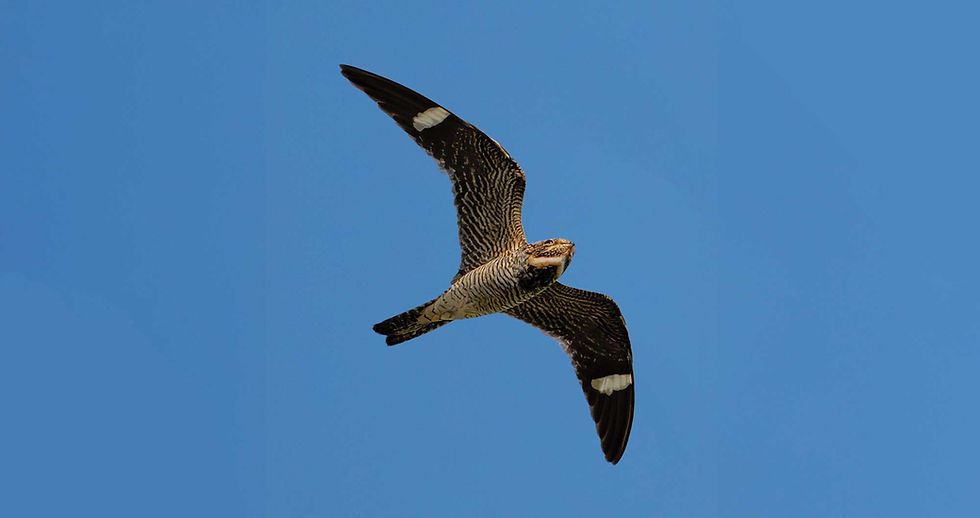
Head out at dusk or dawn to an open woods, cleared forested area, grassland, or urban area. Listen for our buzzy “peent” call and then look up for a medium-sized, slender bird with long pointed wings with white patches just beyond the “elbows” and medium long, forked tail. We’ll amaze you with our bat-like flight of continuous flapping, sporadic glides, and graceful loops. Because of our very short legs, we spend very little time walking on the ground.
During the day and dark of night, we rest motionless on a tree branch, fence post, rock, or ground. Our mottled gray, white, buff, and black feathers camouflage us very well. Our flat heads, short necks, and horizontal resting stance make us look much like a rock or bump on a branch.
MATING
During the breeding season, males conduct unique territorial or courtship flights. They fly slightly above the treetops, then suddenly dive for the ground. As he peels out of the dive, he flexes his wings downward so the wind going over his primary wing feathers makes a deep booming/whooshing sound. This dive can be directed towards intruders, including people, or potential mates. On the ground before a female, he spreads and wags his tail and puffs out his white throat patch while croaking at her.
No nest building for us, females lay their eggs directly on the ground usually in an open spot with gravel, sand, or bare rock, but some prefer a bit softer substrate. In cities they may lay their two speckled eggs on flat gravel roofs. Females mostly incubate the eggs and young leaving at dusk to feed. Both parents feed the hatchlings regurgitated insects.
DIET
We eat almost exclusively flying insects along with a bit of vegetation. Our large eyes help us locate prey in the low dusk/dawn light. We open our tiny beaks revealing a cavernous mouth with which we scoop insects out of the air while in flight.
MIGRATION
From mid-July to early October, we gather in large flocks (frequently numbering in the thousands) to head back to South America. Our winter range covers most of eastern South America almost to its southern tip. In late February to mid-June, we make the return trip to the breeding grounds throughout most of the United States to the tundra of Canada. This route makes us one of the longest distant migrants of any North American bird.
Since 1966, we have lost almost 50 percent of our population.
Scientists believe this is due to reduction in aerial insects because of pesticide use, habitat loss of open areas and flat gravel rooftops in cities, domestic cats, and car collisions. You can help us by using less pesticides, placing gravel pads in the corners of rubberized roofs, keeping pet cats indoors, and preserving open spots with low-growing vegetation.
More from The Greater Valley Guide
The Greater Valley Guide is packed with local events, family-friendly adventures, hidden gems, and community happenings curated to help families connect, explore, and create lasting memories together. Be sure to check out our Calendar of Events for upcoming festivals, fairs, and seasonal celebrations, and be sure to browse our Business Directory filled with local places to shop, play, and discover.